Monday, September 20, 2010

Kilmartin Church & Poltalloch Graveslabs


The church at Kilmartin is host to a Poltalloch enclosure with a display of medieval gravestones.

Notice the mention of the Loch Awe school of sculptures. The Campbells were strong supporters of indigenous art and music, and were fully at home within the West Highland Gaelic world. The Malcolms of Poltalloch are an extremely old family, and even during the MacDonald invasion of the mid 1600s, continued to support the Campbell clan.


Kilmartin Glen and Archaeology


Kilmartin Glen is one of the most important archaeological sites in Europe. Super-ancient items are scattered from one end to the other of the valley. More than 350 prehistoric sites lie within 6 miles of Kilmartin Village. We walked almost the entire length of this place, taking photos throughout. There are plenty of photos on the 'net, so I will show you only 2 of ours: First, finding a 'henge' was a problem, since they tend to lie flat on the landscape. They were popular in neolithic times, and are dough-nut shaped. Being keen of eye, I found one, in a field not far from a much more outstanding group of standing stones. Here it is:
And here are a nearby group of Standing Stones. The resident cattle were using them as scratching posts and windbreaks. Given that the stones are VERY old, whoever set them up were serious builders!


Sunday, September 19, 2010

Ford, and a Standing Stone

Across the road from the Alpaca herd was a Standing Stone. The entire Kilmartin Glen is festooned with such stones (and cairns).

This particular one is broken. According to local information, it was broken at the same time (1879) as the collapse of the Tay Bridge, over the Firth of Dundee, on the other side of Scotland.

Amazing things, those stones.

Ford and the Alpaca Baby


No, we did not go over to Oban this trip. Instead, we concentrated on Kilmartin Glen, Lochgilphead, and south of the Crinan Canal. This meant that we travelled a number of times on the road between Ford and Lochgilphead.

And, the highlight turned out to be an Alpaca farm!

We managed to time our travels with the birth of this little alpaca.

Ford, south end of Loch Awe and a Cairn

After Jura, we found lodgings in the Ford Hotel, 12 miles north of Lochgilphead.

Ford lies at the south end of Loch Awe, a long narrow lake which lies parallel to Loch Fyne.

It was from Loch Awe and surrounding area that Clan Campbell established itself as a powerful family. In 1308, Robert the Bruce defeated the Clan MacDougall at the Battle of the Pass of Brander downstream from the loch.


Across the road from the Hotel is a genuine
Add Imageancient cairn! Yes! The kind that archaeologists love to excavate because they are often burial mounds. However, as far as I can gather, there has been no attempt to dig this up. Really.


Sunday, September 12, 2010

Jura and the Sea

It becomes obvious, as one travels around these islands, that in the old times, the West Highlands was a sea faring area. Today, aside from ferries, there are plenty of yachts, but no birlinns.

The Celtic Galley Association exists to encourage the skills of the sea, "including traditional boatbuilding, sailing, rowing, and seamanship. It also seeks to promote knowledge of the maritime history of the Celtic Seas and to enable a wide range of people to have access to their cultural heritage."

And, of course, there is a book written by Denis Rixson, about this maritime galley. It seems to me that there is, potentially, a really excellent team sport in birlinn racing.


Jura: Standing Stones


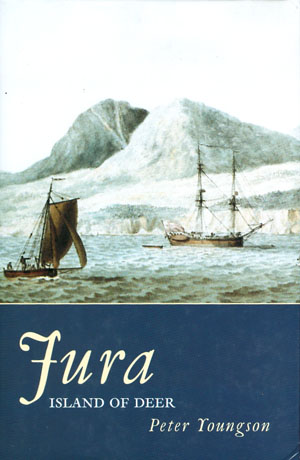
Of course, there are standing stones on Jura. Jura, Island of Deer, by Peter Youngson, proved to be an invaluable guide for this part of the trip. We tracked down the one at Knockrome. There are TWO of them, according to Youngson, but we only found the one, and compared to the others, it was a very small standing stone (we were becoming jaded and picky by this time, I know.) There is a story that when passing between the 2 stones, local people of Jura speak of passing between 'the Two Juras' an act which would bring good luck.


The stone was in a boggy field, beside an airstrip, which itself lies beside an outstanding white sandy beach known as 'Corran Sand'.

Jura: the Telford Pier


My principal aim on going to Jura was to see and photograph the pier at Lagg, across from Kiells, Knapdale. This was part of a drovers' "road", by which cattle were transported across the Jura Sound from the Western Islands to Knapdale, and thence to the Kilmartin tryst, the Falkirk tryst, and into England.

Thomas Telford, a very capable and famous Scottish civil engineer, designed this pier in the early 1800s. He was also involved in the building of the Crinan Canal.

Jura Landscape

Aside from coastal 'microclimates', Jura looks like this:


Dominating the skyline are the "Paps of Jura". "Paps" mean "breasts." While we were there, we met a large retinue of athletes who were going to run up and over the Paps. They all looked very fit. In my opinion, the distillery tourists looked jollier.


Jura: the Hotel, and etc


We stayed at the Jura Hotel in Craighouse, right beside the Jura Scotch Distillery. The latter produces "Superstition" Single Malt Whiskey which is one of my favourite kinds.


These are some of the trees outside of the Jura Hotel, by the way.

Jura: The Hotel, and its landscape


I really enjoyed our stay on this island. It has a very small human population (apparently some 200 people), and a very large deer population. "Jura" means "Isle of the Deer". The people live on the east side of the island (the west is too rocky). On the north end is the Corryvrecken, an outrageously dangerous whirlpool between Jura and the Isle of Scarba. Apparently, it is in full roar during the winter months. Roads up in this part of the Island are rare and difficult. They advise four wheel drive, etc. So, Mary and I did not even try to go that far north. One person who did go up there, and spent the last years of his life in that part of the world, at "Barnhill", was GEORGE ORWELL. While there, he wrote "1984." Given the description of this isolated place, one has to agree that George was a hair shirt kind of guy.

Jura


There is a small ferry that travels across the Islay Sound to Feolin on Jura.

The Feolin Centre is a nascent information centre for Jura. It is part of the Inver Estate, the southernmost estate on Jura.

Islay: Kildalton Cross


Kildalton Cross is the only complete, unbroken, early Christian wheel cross to survive in Scotland. It was carved in the late 700s.

The Cross stands beside a roofless church (probably 13th century). Along an interior wall, there is a very imposing and large carving of a warrior. I don't know whether this was once a burial slab, on top of a grave, or was originally a wall decoration.

Kildalton Church is on the east side of Islay.

Islay: a Standing Stone!

And here is another Standing Stone, north of Loch Finlaggan, beside the road to the Finlaggan Visitor Centre, in a field. Apparently, it was one of two standing stones, observed back in 1695 by Marin Martin (an early tourist who wrote a book of his travels through darkest Scotland). Two large boulders to the east may be the missing second stone. Caldwell thinks these stones may have once been a part of a neolithic monument, now buried. There is a mound behind the visiting centre, which was excavated in 1994/95. A burial chamber (or underground store associated with Iron Age houses) was found here, lined with boulders. (That holding up that stone is me!)

Islay: Finlaggan


Finlaggan, an inland freshwater lake, was the administrative centre of the MacDonald Lords of the Isles. As can be seen by the air photo on the left, the nerve centre consisted of 2 islands: the larger with a chapel, etc., and the smaller, sort of an 'executive suite' for the very important leaders. "Finlaggan" is named after St Columba's contemporary, St. Findlugan. It is probable that the larger island, was, in Celtic times, a Christian centre.


The last of the MacDonald chieftains were executed in 1493 in Edinburgh, and there are only a few remains of what must have once been a bustling and wealthy community. The Lords of the Isles were a seafaring folk, so it is of interest that Finlaggan is inland, on a freshwater loch.

The Chapel was built in the 1300s by John I Lord of the Isles. It is ruinous now, but there are some well preserved grave slabs in the accompanying burial ground. The photo on the right is the grave slab of Donald MacGillispie.


Islay


We travelled on yet another ferry from Kennicraig on West Loch, across the Sound of Jura to Port Ellen, Islay. At this time, there was a major tour of Distilleries, encompassing all ten of them on Islay, plus the one on the Isle of Jura. Therefore, it was really difficult to find accommodation. Through the wonders of Information Scotland, though, we found a room in the Jura Hotel. This meant that we spent more time on Jura than we had planned. In fact, neither of us were much interested in distilleries (although the participants we saw seemed to be having a great time!). I was the unofficial guide of our 'expedition', and so we focussed on Standing Stones and historical centres.

I must recommend our guidebook, a tattered paperback, by a genuine archaeologist, David Caldwell. It was most helpful, especially when we visited Finlaggan on Islay!

Kilberry Castle

As we followed the road north into the heart of Knapdale, we arrived at Kilberry Castle. It was here that the historian, archaeologist and writer, Marion Campbell of Kilberry lived until her death in 2000.


Her nephew, John Campbell and his family, now live on this lovely estate. We were lucky we visited Scotland in the spring. The Western Highlands are truly lovely.


At the entrance of this estate is a display of carved burial slabs, etc., collected and placed within a shelter, for all wayfarers to see!


Stornoway and the Standing Stones

Along the north side of West Loch Tarbert, there is Stornoway Bay (Canadians will be familiar with "Stornoway" as it is the name of the Ottawa residence of the Leader of the Parliamentary Opposition Party). There we saw two impressive standing stones in a field beside the road to Kilberry. These stones are really astonishing, as one wonders the 'why' and the 'how', not to speak of 'my gosh, they've lasted some thousands of years...

Campbeltown, Kintyre


Campbeltown was once a bustling port, home to many very wealthy traders as well as landowners. Its buildings are even now, impressive in an early Victorian manner. As the Clydebank shipping industry died after WWII, Campbeltown is a quiet town on the south end of Kintyre.


It is a beautiful place, though, and its harbour is filled with yachts, etc.


Campbeltown has a successful scotch distillery, a very old one, too. It is the oldest independent family owned distillery in Scotland. Founded in 1828 on the site of Archibald Mitchell's illicit still, the Springbank Distillery is now in the hands of his great great great grand son, Hedley G. Wright.

Owned by Mr Wright's J&A Mitchell & Co Ltd, Springbank is the only distillery in Scotland to carry out the full production process on the one site. 100% of the traditional floor malting, maturation and bottling is done at the distillery in Campbeltown.

It produces the most hand made whisky in Scotland, with traditional production methods being used throughout the process, and human involvement at each and every stage.

It is the only distillery in Scotland to have never chill-filtered, nor do they add any artificial colourings to any of their single malts.
It is the only distillery in Scotland to produce three different single malts, Springbank, Longrow and Hazelburn, using three different production methods.

Not very far south of Campbeltown lies the Mull of Kintyre. We did not go down there this trip, but I must share an interesting fact: "mull" derives from the Gaelic "maol", which means a 'rounded hill, bare of trees' OR a bare forehead, or shaved head. Which reminds me of MAELRUBHA, that Celtic Saint I wrote about in Knapdale People Site!

Saddell Abbey

There is a one-lane road (paved!) down the east side of Kintyre. Only 13 km north of Campbeltown, we came to an evocative and moving ruin: Saddell Abbey.

. Saddell Abbey was founded in the late 1100s by Somerled (progenitor of the MacDonald Lords of the Isles), or by his son, Reginald. The Cistercian "Grey Monks" worked these lands until the late 1400s, by which time the MacDonald Power had been broken by the King of Scotland. The Grey Monks left, and the Abbey, and its lands, were granted to the Bishopric of Argyll.


Aside from the stone remains scattered through a park like area, there is (within a well built shelter ) a very fine collection of grave slabs. Originally they marked graves of knights, bishops and monks.